

Most advice about running a business says the same thing: reduce the friction. Cut the steps, cut the sign-offs, cut the paperwork. Most of the time, that advice is right.
But not every step that slows you down is red tape. Some of them are safety nets. Take those out and you don't get a smoother business. You get mistakes nobody catches, people who never learn the work properly, and decisions made faster than anyone thought them through.
So before you streamline a process, automate it or hand it to AI, it's worth asking a different question: which steps are red tape, and which are safety nets?
Red tape: the steps worth removing
Red tape is effort that adds nothing. It's the same work done twice, or time spent looking for things that should be easy to find. Common examples:
Typing the same client details into the CRM, then a spreadsheet, then an email.
Chasing an approval that has been sitting in someone's inbox for three days.
Hunting for the latest version of a file.
Waiting on the one person who knows how something works.
Re-explaining the same process every time someone new joins.
None of these make the work better. They just make it slower. This is where templates, better systems and automation earn their place.
Safety nets: the steps worth keeping
A safety net slows things down on purpose, because it protects something. For example:
A second look before a quote or invoice goes out.
A proper handover conversation when work changes hands, not just a forwarded email.
Thinking time before a decision that is hard to undo, like a new hire or a price change.
Letting a newer team member work something out before you step in.
The three-question test
Pick any step in a process and ask:
Does it catch mistakes?
Does it build someone's skill or judgement?
Does it make someone stop and think before a decision that matters?
If the answer to all three is no, it's red tape. Remove it, simplify it or automate it.
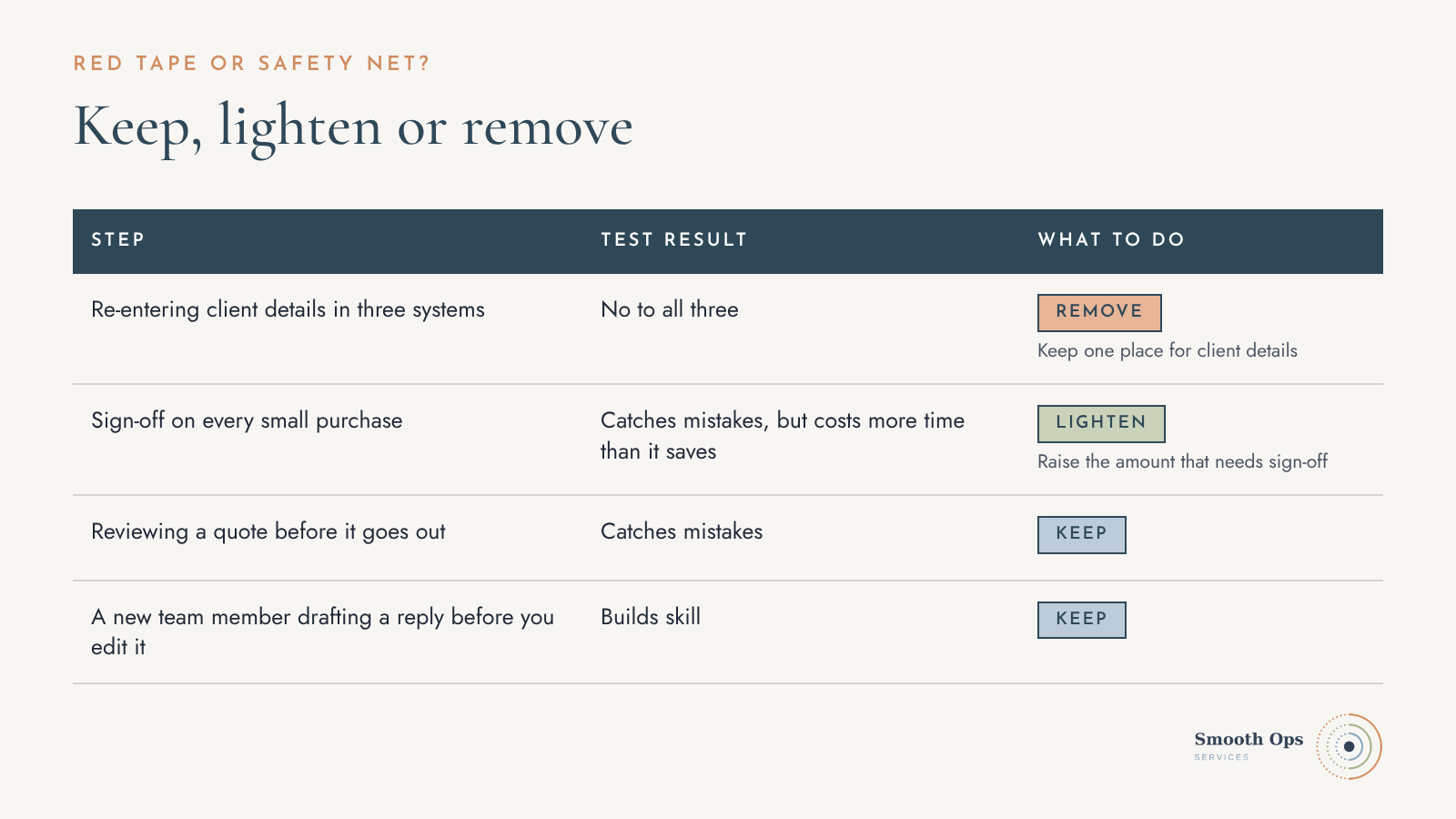
If the answer to any of them is yes, it's a safety net, so keep it. You might still make it lighter, such as a short checklist instead of a meeting, or a quick review instead of a full sign-off. Just don't cut it because it slows things down.
Why this matters before you automate
Automation, with or without AI, is very good at removing steps. It doesn't know which ones were safety nets. Automate a process without sorting it first and you can lose the useful checks along with the red tape. Sort first, and the speed goes where it actually helps.
Try it on one process this week
Choose one process that feels slow, such as onboarding a new client or approving a purchase.
List every step, including the workarounds.
Run each step through the three questions.
Mark it keep, lighten or remove.
Fix the "remove" steps first. They're usually the quickest wins.
You'll probably find most of it is red tape. The point is to find the safety nets before they disappear.
If you'd like a second pair of eyes on a process, that's the kind of work we do at Smooth Ops Services.
Source note: Example steps are general illustrations, not client stories.